On this page
Take action
How to respond to the consultation
Last reviewed: August 2026
In a nutshell
This is the final public consultation on the South Warwickshire Local Plan — the Regulation 19 (Publication) stage — before the plan goes to an independent government inspector. It is open now and closes on Tuesday 8 September 2026. Comments about site KEN.1 (formerly SG04) are what the inspector will later read. The online version is easier and more direct — you can access it here. If you prefer, you can also download a PDF or Word form to complete and submit by email.
Why your response matters
We need Warwick District Council, Stratford-on-Avon District Council and the inspector to hear from as many people as possible about KEN.1 — the fields south of Kenilworth proposed for around 750 homes. We will also submit our petition (with over 3,400 signatures), but individual responses are even more meaningful.
What the consultation is about
At this stage, the consultation is limited to whether the draft Plan is “legally compliant and sound”. This has a specific legal meaning, namely whether the plan has been properly prepared, whether it is justified, effective and consistent with national policy.
We have prepared a suggested response, focusing on 4 key reasons why the plan is not sound in relation to KEN.1. Feel free to use this as you wish - you can copy and paste it, or adapt it to include your personal views.
How to respond
The councils’ consultation page has full details, including their own step-by-step video and PDF guide. In short there are two ways to respond:
- Via the online portal The link opens the site proposals page and should scroll to KEN.1. You can click Comment within the KEN.1 section and start your response from there. You will need a free account.
- If you prefer, there are forms you can download as either PDF or Word to complete offline, and emailed to swlp@warwickdc.gov.uk.
Step-by-step: the online portal
These steps follow the online form. The downloadable PDF or Word form asks the same questions, so you can use the same answers either way.
-
Open the consultation page (or jump to KEN.1)
Start from the consultation homepage, or skip ahead with this direct link to KEN.1.
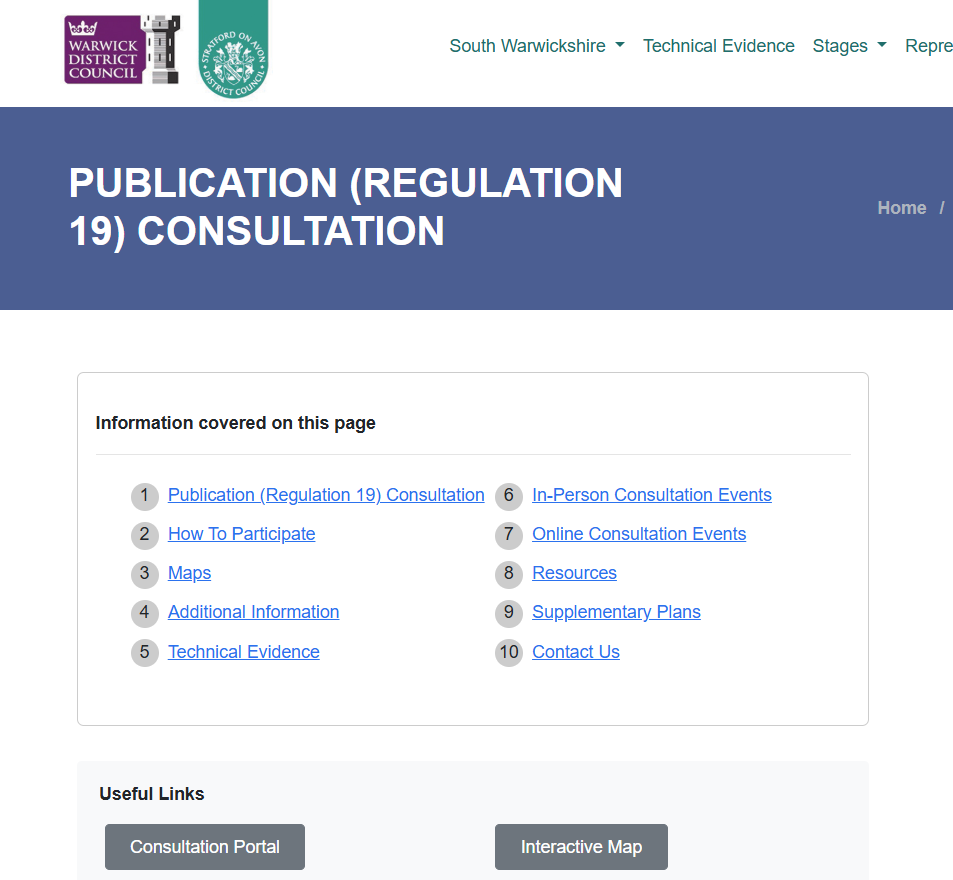
The councils’ Regulation 19 consultation page. -
Find KEN.1 under Site Proposals
If you use the homepage route, scroll to the chapter tiles and open Site Proposals (the last purple box). In the list of sites, look for KEN.1 – Kenilworth – Land to the south (highlighted in the screenshot below).
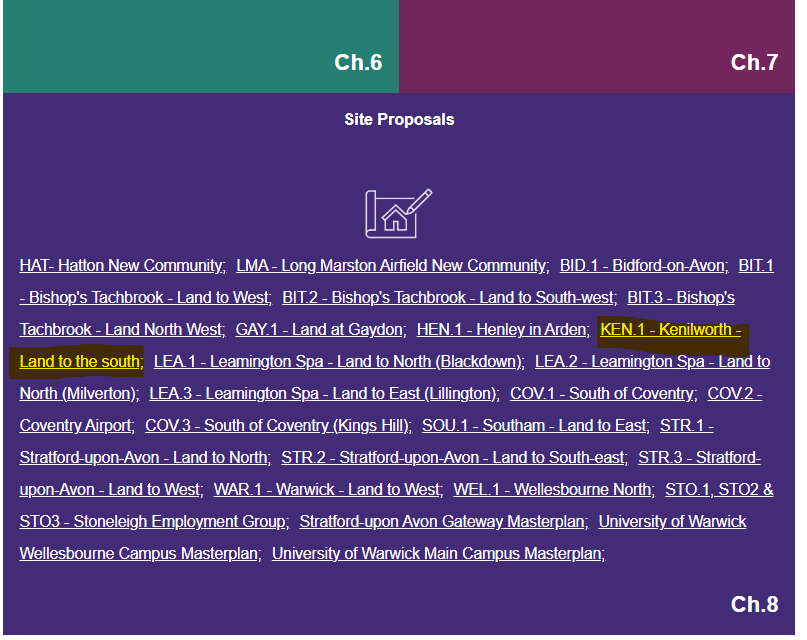
KEN.1 in the Site Proposals list on the consultation portal. -
Click Comment and sign in
On the KEN.1 page, click Comment. You will be asked to log in or create a free account. When you sign up, accept the terms and — in the long list of topics — you can choose to be contacted only about representations you have made.
Until you click Submit at the very end, you can move back and forth on the form. Clicking Next is not final.
-
Answer the first questions
The form starts by asking whether you Support, Object or Comment. Choose Object, then click Next.
You are then asked whether you think the plan is legally compliant and whether it is sound. We suggest answering No to both — for the reasons in the suggested wording further down this page — then click Next again.
- Support / Object / Comment → Object
- Legally compliant? → No
- Sound? → No
-
Write your representation
This is your main chance to explain why you object. If your comments run to more than 100 words, the form adds a second box asking for a summary of 100 words or fewer. Suggested wording for both boxes is further down this page.
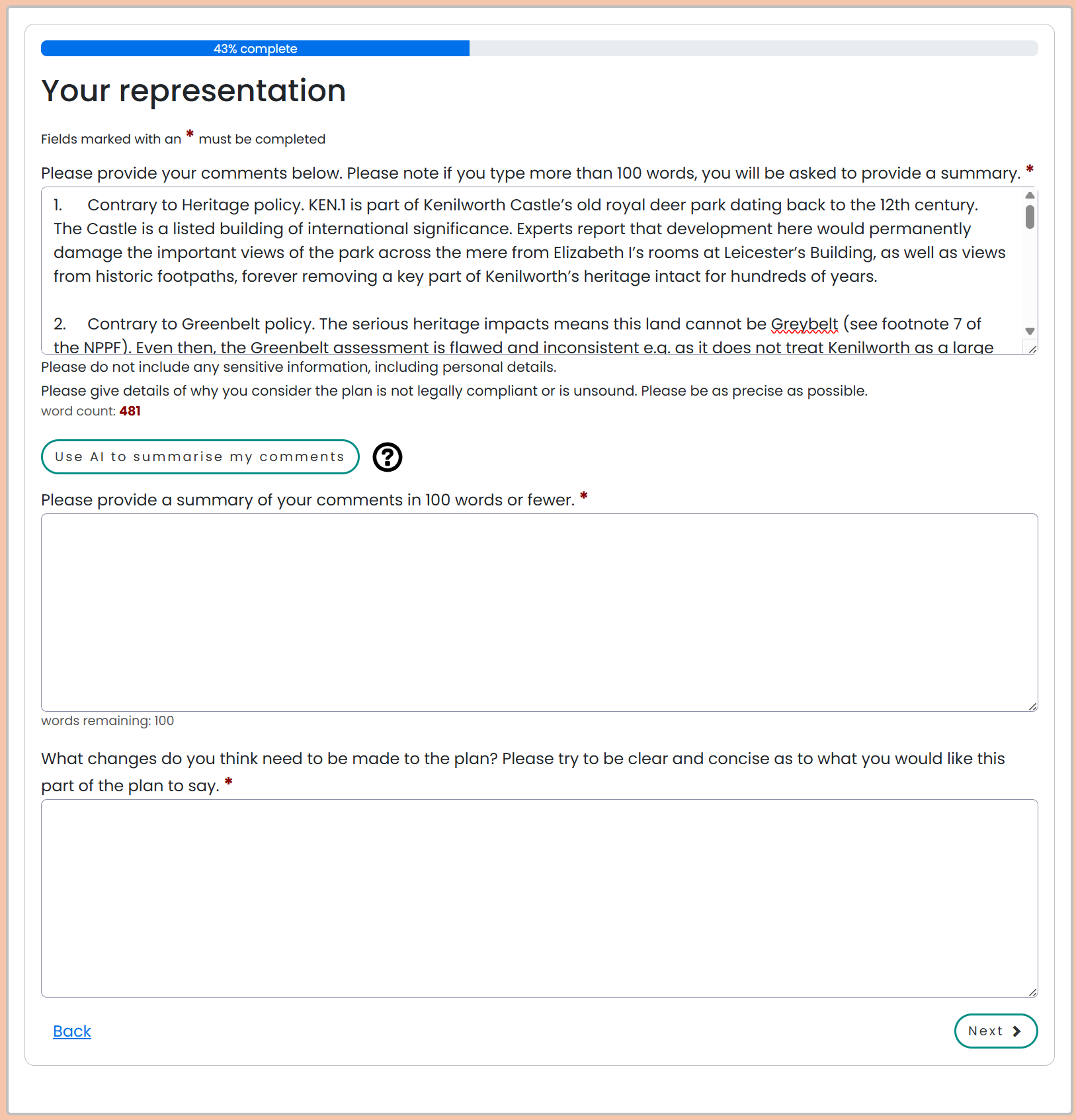
Once you pass 100 words, the form asks for a short summary as well. You can ignore the portal’s “Use AI to summarise” button and paste our summary instead. For What changes do you think need to be made to the plan?, keep it simple. We suggest: “Remove KEN.1 from the Plan.”
-
Optional uploads and hearing attendance
You can upload supporting documents (photos, reports, letters) if you have them. Save Our Fields is submitting expert evidence on heritage, legal points, ecology, highways and related topics — you do not need to attach those yourself.
You will also be asked whether you want to take part in the inspector’s hearings. That is optional. Representatives from Save Our Fields, the Town Council and others intend to attend. If you select Yes, you will need to say briefly why your attendance is necessary (for example, important local evidence or specialist expertise).
-
Submit
Review your answers, use Back if you need to amend anything, then click Submit. Thank you — every response helps.
Suggested wording
Use these as a starting point. Copy them as they are, or — better still — adapt them and add anything from your own knowledge of the fields, roads, wildlife or heritage. For more background see why these fields matter.
Main comments (about 500 words)
The draft plan is not “sound”, and KEN.1 should be removed from it, for the following reasons:

1. Contrary to heritage policy. KEN.1 is part of Kenilworth Castle’s old royal deer park dating back to the 12th century. The Castle is a listed building of international significance. Experts report that development here would permanently damage the important views of the park across the mere from Elizabeth I’s rooms at Leicester’s Building, as well as views from historic footpaths, forever removing a key part of Kenilworth’s heritage intact for hundreds of years.

2. Contrary to Green Belt policy. The serious heritage impacts mean this land cannot be grey belt (see footnote 7 of the NPPF). Even then, the Green Belt assessment is flawed and inconsistent — for example it does not treat Kenilworth as a large built-up area, so fails to recognise the effects of urban sprawl. These Green Belt fields perform an important and widely recognised function in keeping Kenilworth from merging with Leek Wootton. There are less harmful, more sustainable alternative locations for affordable housing, which have not been properly assessed.

3. Ecology: no assessment or protection for important species. The KEN.1 fields contain important hedgerows, mature field oaks, rough field margins and numerous ponds populated by a large variety of wildlife, with many protected species thriving in the area: rare birds, great-crested newts, bats, and wild deer echoing its historic past, all recorded carefully by residents. There has been no proper assessment of these, contrary to legal requirements. The plan provides no justification for permanently damaging this thriving biodiversity, and the 10% Biodiversity Net Gain proposed is unachievable and unevidenced.

4. Major infrastructure and viability concerns, all unresolved in the evidence.

a. The site is not a 20-minute neighbourhood but sits on a narrow country lane unsuited to major traffic, and a key route for cyclists and walkers. The roads are already under huge pressure from the expanded abattoir, congestion in the area, and new housing commitments at Rouncil Lane and Leek Wootton. KEN.1 would require major road upgrades including a costly new roundabout, a second access on Rouncil Lane and a spine road to connect to Warwick Road. None of this has been properly costed and it undermines the proposal’s deliverability and viability.

b. The infamous long-term sewage problems along Rouncil Lane, linked to servicing the very busy abattoir, will be compounded by this level of further development. The system cannot cope now, and enforcement by statutory agencies has failed over 25 years. No resolution or costings are proposed.

c. Primary and secondary education provision in the town is at or nearing capacity. New school capacity is not proposed (only off-site contributions). The same is true of GP capacity. Existing facilities cannot soak up yet more housing in the area.

d. KEN.1, although a “strategic location”, has not been subject to proper viability analysis, despite the major infrastructure required. Its deliverability has not been evidenced. And, this is likely to undermine levels of affordable housing over time if the allocation is allowed to proceed.
100-word summary
The SWLP is not sound. KEN.1 should be removed:

1. Contrary to heritage policy. KEN.1 was Kenilworth Castle’s old royal deer park, a key part of the historic landscape. Experts indicate that development would permanently damage this rural setting of international significance.

2. Such heritage land cannot be grey belt. The Green Belt assessment is flawed.

3. No proper assessment of important species. A range of protected and important rare species thrive here. These would be unjustifiably lost.

4. Major infrastructure and viability concerns (highways, education, sewerage) are all unresolved and unjustified in the evidence.
More background
- The SG04 / KEN.1 site explained
- How the planning process works (including soundness and the Green Belt)
- Where the South Warwickshire Local Plan has got to
- Sign the petition